Grinnell College Logo

Funeral for Asafo Officer Video Selection

Video Selection:

At the home of the deceased, the coffin is placed at one end of a courtyard along with family members. The asafo company is set up beneath a canopy at the other end of the courtyard. The video clip begins with a cantor and the chorus performing an unmetered song overlaid by the drummer of the asafokyen performing in the speech mode of drumming while company members spontaneously contribute outbursts of warrior-like movements and acrobatics.
<cross dissolve>
Family members of the deceased dance to full ensemble accompaniment.
<fade out>
Coffin being prepared for the soon to take place procession following the present ceremony.
<cross dissolve>
The entrance of what is perhaps the most spectacular of all Fante asafo flags–approximately 200 feet long with dozens of appliquéd vignettes each of which would be the subject matter of a typical flag–that eventually surrounds the courtyard in which the coffin rests. More family members grieve through dancing inside the space articulated by the flag.
<fade out>
Following the exit of the flag, the asafo company’s frankakitsanyi (flag bearer) performs a stylized flag presentation to the accompaniment of the asafokyen and unmetered singing. The company’s linguist then explains the image appliquéd on the flag (usually a proverb or a dream) to members of the company.
<fade out>
The frankakitsanyi then performs the flag presentation for the family of the deceased.
<fade out>
While the full asafo ensemble performs in the background, a family member of the deceased pours libations to the ancestors.
<cross dissolve>
Officers of the company move in a line from the company’s side of the courtyard to the family’s side, and then back, as a gesture of respect.
<fade out>
Coffin is lifted atop the heads of the four men
<end of video clip>
who will transport the body first to the post of Asafo Company No. 6, which is decorated with numerous company flags, and then on to the Catholic church for a service. The burial takes place later the same day.

<<                                                                            >>

Posted on

Funeral for Asafo Officer

A flag being presented by waving at a funeral
Flag presentation at the funeral for an asafo officer

What follows is a video documentation of part of the funeral rites for Obaapanyin Ekua Samanpe, which took place at the deceased’s residence in Anomabu on April 3, 1993. She was an officer in the Asafo Co. No. 6 of Anomabu, and the segment of her funeral rites documented here was the one in which her company members played a prominent role. Following this send off, there was a funeral service performed for her at her church.

For a Fante, one of the benefits of belonging to an organization in life is that the organization’s membership will assist in making one’s funeral–seen more as a transition into the realm of the ancestors than as an end of life–a memorable one. Because Ekua Samanpe was a prominent member of her asafo company, her funeral was perhaps more dramatic and spectacular than funerals for rank-and-file members. The appearance and incorporation of the impressive long flag belonging to this company that you will see in this footage is a sign of the high position the deceased held in this organization.

<<                                                                        >>

Posted on

Events Involving Music

An outdoor procession celebrating the enstoolment of a new chief with umbrellas and banners
A procession celebrating the enstoolment of a new chief

While many of the documentations of Fante music genres presented in the “Spheres of Music Making” section of this site were made at specially arranged sessions for my research project, I was able to document, mostly on video tape, components of four unsolicited events involving musical performance–two funerals, the enstoolment of a chief, and a community-wide festival of thanksgiving. Each of these events was multifaceted and unfolded over several hours or days, in multiple locations, and sometimes while on the move. As a cultural outsider, I wasn’t even allowed to attend certain components of some of these events. It was simply impossible for me to take in, much less document, all the symbolic actions, musical or otherwise, that contributed to these events. At best, these four events as presented here are my reconstructions of them based on what I took in from my vantage point within the complex realities of these spontaneously unfolding and, for me, totally new experiences. However, they should serve to convey to you some sense of the rich texture of symbolically meaningful verbal, spatial, musical, kinetic, sculptural and visual gestures that are drawn upon by the Fante of Anomabu as they affirm, explore, and celebrate their collective identity and shared lifeways.

<<                                                                       >>

Posted on

Brass Band Audio and Video Selections

Audio Selection:

This is hymn music that, when sung, would be organized in the call-response fashion. When such music gets arranged for brass band, the trumpet player becomes the equivalent of the cantor/caller, the rest of the band the chorus. This should be readily audible in the audio clip. You should also be able to clearly hear the persistent highlife beat performed on the afirikyiwa and cymbals. The drums–all modeled on western membranophones–provide a dense and energetic rhythmic underpinning for the hymn.

Video Selection:

The video clip offers a visual overview of most of the instruments in the ensemble and includes quite a nice display of drumming by one of the group’s two side drum players.

Performance Forces:

afirikyiwa metal castanet consisting of a wide ring worn on the thumb and a somewhat globular-shaped bell hanging from the second finger of the same hand; time-keeping instrument in adenkum, tigari, kolomashie and apatampaensembles, and in the ensemble for the Awerekyekyer church organization
cymbals metal concussion vessels, imported European crash cymbals; time-keeping instrument
adawur ntaa double iron bell, clapperless, struck with wooden stick, also called gongon; support time-keeping instrument
2 side drums double-head drum with cylindrical body played with a pair of stick beaters, basically an imported European field drum (without snares) or modeled after such a drum; rhythmic instrument
conga pair of single-headed tubular hand drums with a conical bodies mounted on a stand, local adaptation of the Latin American conga; rhythmic instrument
bass drum double-head cylindrical drum with large diameter, struck with a stick beater, imported from Europe or modeled after European bass drum; rhythmic instrument
trumpet end-blown lip-reed horn with valves, soprano register, imported European trumpet; lead melodic instrument
2 trombone end-blown lip-reed horn with valves, tenor register; imported European valve trombone; melodic support instrument
2 tenor end-blown lip-reed horn with valves, tenor register; imported European baritone horn; melodic support instrument
bass end-blown lip-reed horn with valves, bass register, sousaphone-like; melodic support instrument
bass end-blown lip-reed horn with valves, bass register, tuba-like; melodic support instrument

<<                                                                             >>

Posted on

Brass Band

Brass Band of Ogoekrom perform instruments under an awning while outside
Brass Band #2 of Ogoekrom

The small farming village of Ogoekrom is one of the satellite villages in the Anomabu Traditional Area. (map) Located on a dead-end road about five miles inland from the coast, it is about the last place on earth you would expect to come across a brass band. But, due to Methodist missionary contacts earlier this century, a set of battered old British-made instruments does exist there, and the subsistence farmers who play them are hired two or three times a month to provide lively music for festivals and funerals in surrounding towns and villages–including Anomabu. Ogoekrom has had a brass band since 1954. The original group disbanded sometime in the 70s, but was revived in 1983 and named Ogoekrom Brass Band #2. The group’s repertoire consists of at least twenty pieces, most of them church hymns or highlife tunes grouped into four categories according to the particulars of their tempo, meter, and drum rhythm: warries (waltzes), bruse (blues), highlife, and adaha. The two melodies heard on the next page, Yesu ye medze (Christ is Mine) and Nyame ye osahen (God Is King of All Warriors), are both church hymns performed to the highlife beat. No one in the group reads music; arrangements are worked out by ear and elaborated spontaneously in performance by the individual players. The group plays for funerals and community celebrations.

<<                                                                                    >>

Posted on

Bosoe Audio and Video Selections

Audio Selection:

The musical texture of bosoe music consists of time keeping instruments (afirikyiwa and clips) playing the highlife timeline, a pair of rattles, and three drums–none of which seem to be operating in the capacity of a lead drum–each contributing a slightly varying rhythmic line to the basically regular, almost ostinato-like beat that underlies the music, and a vocal call-response layer. These various musical components can be focused on in succession as you listen to the audio clip.

Texts / Translations for the Songs Heard on the Audio Example:

Nsaamaa nyimpa n’ewiei
Ankwa aroma egyanka dabi meye yie

[expresses the sad end of man–lit., maggots determine the end of man.; will a lonely bird (an orphan) ever prosper?]

Ankwa aroma a oroko e gyina ho Ayee o
ayee asra womba ahwe?

[cautions the lonely bird to look after its young ones well]

“Boy” e hwe me nantsew mu e
“Boy” e w’aye m’adze hwe me nantsew muo
Moso m’abe kentsen kor a mereye m’aye yie befa ko

[a lady is telling her false lover (“boy”) that despite her precarious situation, she has still managed to get a basket full of palm fruits and that he can come and take it away]

Ao monua gyae su
Woara nyin de owu nhye de
Woara nyin de baako ye mbobor

[a song consoling someone in distress–“my brother/sister stop crying,” “death never announces the day of its action,” “it is evident a lonely person almost always suffers”]

Ero “Mary” ekonee akyer o
Aye bohwe wo mba

[a call to the Virgin Mary–a piece usually used in ending bosoe performances]

Video Selections:

The video clip, in addition to providing you with an opportunity to associate the instrumental timbres with the instruments on which they are produced, allows you to briefly see the bosoe dance style and, perhaps more importantly, affords you a glimpse at how young children receive their “music education”–in their mothers’ arms or on their backs, or on the edge of the performance space where they are free to mimic the movements of the adults present.

Performance Forces:

two afirikyiwa metal castanet consisting of a wide ring worn on the thumb and a somewhat globular-shaped bell hanging from the second finger of the same hand; time-keeping instrument
clips wooden concussion sticks, modeled after Latin American claves; time-keeping instrument
awosua a pair of maraca-like internal seed rattles; rhythmic instrument
bosoekyen single-head tubular hand drum, elongated barrel shape, head attached with pegs; rhythmic instrument
akonkon small military-style side drum, double headed, cylindrical body, struck with one wooden beater; rhythmic instrument
tamalin a large rectangular frame drum struck with the palm; rhythmic instrument
cantors female, two trading off
chorus mixed, approximately eighteen

<<                                                                                     >>

Posted on

Bosoe

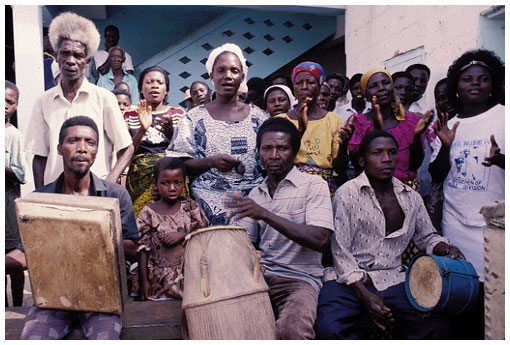
A group of Ekurobadze known as Bosoe perform with drums while seated and standing outside
Bosoe group of Ekurobadze

Bosoe is a highlife-influenced recreational form of music, not of Fante origin, that at one time had widespread popularity amongst the Akan peoples of southern Ghana. The word “bosoe” means, roughly, to “beat on the drum.” There is a specific dance movement quality that goes along with the rhythmic feel of this music, and the song texts can be on a variety of topics including love, history, morals, religion or events of local interest.

The group recorded here is from Ekurobadze, one of the satellite villages in the Anomabu Traditional Area. (map) In existence for approximately twenty years (as of 1993), membership in this group is open to all members of the community. It is a benevolent society, so it performs for free for members of the group when the occasion arises. The ensemble performs in its home village and nearby communities for funerals and other events. Although not an ensemble of chieftancy, this group on occasion accompanies their village chief to events. This was the only recreational music association in Ekurobadze at the time of the recording; the village has one asafo (warrior) company, which includes a musical component.

<<                                                                                 >>

Posted on

Apatampa Audio and Video Selections

Audio Selections:

The tempo of apatampa seems on average to be slower and more relaxed than is the case with most other Fante recreational music. The drumming is likewise less intense, but involves an interesting interaction between adana and akonkon as they periodically approach a cadence. The double-bell (adawur ntaa) player seems to be free to simply be inventive in the two-pitched rhythms he creates. In the vocal call-response interaction, much of the time the cantor seems to sing an entire lengthy phrase followed by the chorus presenting the same material.

Texts / Translations for the Songs Heard on the Audio Example:

Meba ewu beebi a wonnye wo nnko o.
Moko m’akotow akorafo mpa.
Kramo e [meba rowu] o Alla Kubalu
To no Abudu, Maama.

[My child is dying], what should I do.
Alhaji, name him (my child) anything you want,
Abudu, Maama (two possible names)

[Apofo woroko wonnko ma nam wo!]
[Fishermen, go to where there are fish!]

M’ahwe me nsakyir dzinn, me nsa ekyir onntse de mensa yam.
[Awoo wowo no woara wo yam.]

I have examined the back of my hand, and it is not the same as my palm.
[Your real child is the one from your womb.]

[Gyae akoratwe] bembam, twentwean.
Gyae akoratwe a honam ye yie.

[Stop fighting your rivals] and grow fat. Note: meaning, wives should not fight among themselves–one cannot prosper (i.e., grow fat) in that sort of situation.

Video Selections:

In the video clip you can see the female singers moving in a distinctive way to the beat of the music as they sing; one of them is blowing the whistle rather than singing. Later in the clip different components of the instrumentalists are focused on–first the adaka and akonkon are seen, then the adawur ntaa and the male singers.

Performing Forces:

afirikyiwa metal castanet consisting of a wide ring worn on the thumb and a somewhat globular-shaped bell hanging from the second finger of the same hand; time-keeping instrument
aben single-note tin whistle (duct flute); time-keeping instrument
adawur ntaa double iron bell, clapperless, struck with wooden stick; support time-keeping instrument
adaka a large rectangular plywood crate with sound hole, slapped and pounded (struck) with the player’s fists or palms; lead rhythmic instrument
akonkon small military-style side drum, double headed, cylindrical body, struck with one wooden beater; interacts rhythmically with the adaka part
cantors female, two trading off
chorus mixed, approximately ten females and eight males

<<                                                                                 >>

Posted on

Apatampa

An Apatampa group of Anomabu perform outside a small grey brick building
Apatampa group of Anomabu

Apatampa bands have male and female singers (although the females seem to usually predominate) accompanied by an unusual set of instruments performed by males. The lead drum of this ensemble is not really a drum at all, but a large rectangular plywood crate (about 4x2x1.5 feet) called adaka. One end of this instrument rests on the drummers lap, the other on the ground. By striking various areas with either clenched fists or open palms, a variety of membranophone-like sounds are produced. The rhythms

Adaka and Akonkon perform in a group outside a small brick building
Adaka (left) and akonkon (right)

performed on the adaka mix with those played on a real drum, the akonkon, itself interesting in that it is obviously of European origin. A single-pitch metal whistle (aben), not unlike signal whistles one would expect to hear on boats, provides a doubling of the highlife-based bell pattern played on the afirikyiwa. One wonders if long contact with European traders in some coastal Fante port such as Anomabu wasn’t responsible for the unusual collection of instruments found in apatampa recreational bands (the only clearly indigenous instrument used by this group is the time-keeping afirikyiwa). The Anomabu group heard in this selection had been together only three years at the time of the recording in 1993.

<<                                                                               >>

Posted on

Adenkum Audio and Video Selections

Audio Selection:

Three things to focus on while listening to the audio selection are: the time keepings role of the afirikyiwa, adenkum and abaa; the unrelenting, inflected, rapid-fire dondo part; and the call-response interaction of the voices.

Texts / Translations for the Songs Heard on the Audio Example:

[Obo Onomabu* bra begye nsa.]
Afe aso bra begye nsa.
Nana Kweku Wobir
.
[The stone should come for a drink.] (note: a formula used when pouring libations.)
Another year is here for us, come for a drink.
Nana Kweku Wobir. (note: possibly a powerful god in the area.)
*Obo Onomabu=Obonoma=rock bird=Anomabu (Anomabu is built on a rocky outcrop. The town was given its name because birds liked to alight on the rocky shoreline where it was built.)

[Awar bi ye musu/asan.]
Oadaadaa me akyere amanmba.
Medze moho rokosom awar a.

[Some marriages can produce calamities.]
Some marriages can be omen producing. note: the gist of this text is that a woman has tried to serve under the bondage of marriage, but has been made a fool of before the entire community.

[Aborofo woato nsa afre hen.]
Aborofo woetu kyew fre hen.
Yewosow yewoyow aborofo wotu kyew fre hen.

[The white men have invited us.]
The white men have doffed their hats for us.
We shake and shake (the adenkum rattles), we make good music for the white men.

Video Selection:

During the video clip you will be able to see the distinctive movement quality of the adenkum dance. The Fante are a head-bearing culture (they carry loads on their heads, not their shoulders or backs), and there is an impressive segment where one of the dancers balances a basin containing the group’s spare dondo on her head. Other segments of the video allow you to see how the two drummers coordinate their parts.

Performance Forces:

2 afirikyiwa metal castanet consisting of a wide ring worn on the thumb and a somewhat globular-shaped bell hanging from the second finger of the same hand; time-keeping instrument
several abaa a pair of bamboo concussion sticks; time-keeping instrument
5 adenkum gourd rattle with an external net of beads, shaken or stamped against an open palm; time-keeping instrument
2 dondo double-headed pressure drum with hourglass-shaped body, struck with a single hook-shaped stick, only one head is struck; a pair of these is used in an interlocking pattern to provide a rhythmic ostinato
cantors female, two trading off
chorus female, approximately fifteen

<<                                                                              >>

Posted on
The views and opinions expressed on individual web pages are strictly those of their authors and are not official statements of Grinnell College. Copyright Statement.